
Crafting Robust Product Listings in WooCommerce
What you'll learn
 Product Data ModelingVariable Product ImplementationE-commerce API DesignDatabase Schema Optimization
In the vast and competitive landscape of e-commerce, the efficient and accurate management of product listings is paramount. For open source web software developers tasked with building or extending online stores, understanding how to effectively handle both straightforward simple products and the more intricate variable products is a foundational skill. This article delves into the architectural considerations, database schemas, and API design patterns required to create robust and flexible product listing systems capable of managing physical goods with diverse characteristics like sizes, colors, and prices.
Understanding Simple Products
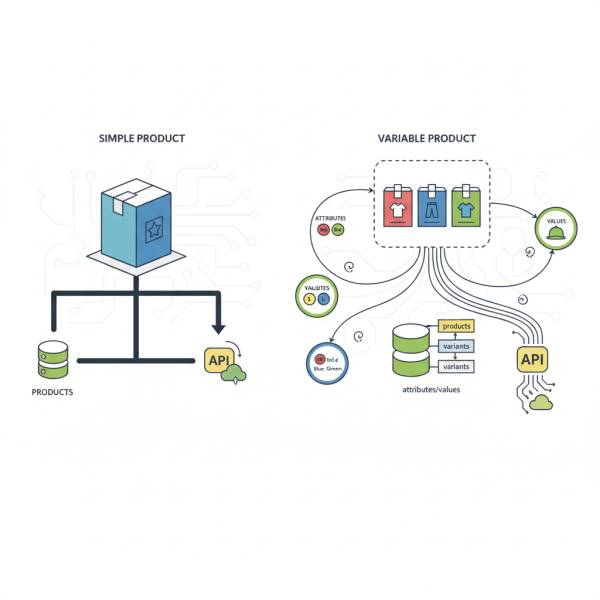
A simple product is, as its name suggests, a singular, distinct item with no variations. It has one SKU, one price, one inventory count, and a fixed set of properties. Think of a specific book, a unique piece of art, or a single-flavor candy bar. From a data modeling perspective, a simple product typically maps directly to a record in a main products table, with all relevant details stored as columns within that single record.
The simplicity of these products makes their implementation relatively straightforward. Creating, reading, updating, and deleting (CRUD) operations for simple products usually involve direct interaction with a single database table. Their predictability also simplifies frontend rendering and backend inventory management.
The Nuance of Variable Products
Variable products, however, introduce a layer of complexity by allowing a single product concept to have multiple variations based on specific attributes. A T-shirt available in different sizes (S, M, L, XL) and colors (Red, Blue, Green) is a classic example. Each unique combination of attributes (e.g., Red, Large T-shirt) constitutes a distinct product variant, often requiring its own SKU, price, image, and inventory level. This flexibility is critical for retailers but poses significant challenges for developers in terms of data storage and system design.
The core challenge lies in representing the relationship between the parent product, its attributes, and the individual variants efficiently. A poorly designed system can quickly lead to data redundancy, inefficient queries, and a cumbersome user experience for both administrators and customers.
Database Schema Design for Flexibility
A well-structured database schema is the cornerstone of any scalable e-commerce platform. For variable products, a normalized approach is generally preferred to avoid data duplication and ensure data integrity.
Consider the following tables:
products: Stores common information for the parent product, such as name, description, brand, and a flag indicating if it's a simple or variable product.product_variants: Each record here represents a unique variation of a parent product. It would include columns forproduct_id(foreign key toproducts),sku,price,stock_quantity, and potentiallyimage_urlspecific to that variant.attributes: Defines the types of attributes, e.g., 'Color', 'Size', 'Material'. Columns would beid,name(e.g., 'Color'),slug.attribute_values: Stores the specific values for each attribute type, e.g., 'Red' for 'Color', 'Large' for 'Size'. Columns would beid,attribute_id(foreign key toattributes),value(e.g., 'Red'),slug.product_variant_attributes: A pivot table linkingproduct_variantstoattribute_values. This table resolves the many-to-many relationship between a variant and its descriptive attribute values. It would containproduct_variant_idandattribute_value_id.
This structure allows for highly flexible attribute definition and variant creation. When querying for a specific product variation, you would join across these tables, starting from products, then product_variants, and finally using product_variant_attributes to filter by the desired attribute_values.
API Design for Product Management
For open source developers, designing a clean and intuitive API is crucial for system integration and future extensibility. RESTful principles are typically applied here.
Endpoints for Products:
GET /products: Retrieve a list of all products.GET /products/{id}: Retrieve details for a specific product, including its variants if it's a variable product.POST /products: Create a new product. The payload would differ for simple versus variable products.PUT /products/{id}: Update an existing product.DELETE /products/{id}: Remove a product.
When creating or updating a variable product via POST /products or PUT /products/{id}, the API payload needs to accommodate the nested structure of variants and their attributes. A common approach is to include an array of variant objects within the main product object. Each variant object would contain its SKU, price, stock, and an array of attribute-value pairs (e.g., [{attribute_id: 1, value_id: 5}, {attribute_id: 2, value_id: 8}]).
Careful validation is essential to ensure that attribute combinations are valid and that all required information for each variant (like unique SKUs) is provided. Error handling should clearly indicate missing or incorrect data, guiding the client developer to correct their requests.
Frontend Integration and User Experience
While primarily a backend and API discussion, it's worth noting how these structures impact the frontend. For variable products, the frontend often needs to dynamically display options (e.g., dropdowns for colors and sizes). As a user selects options, the frontend should query the backend for the specific variant that matches the selected attributes, retrieving its unique price, image, and availability. This often involves client-side JavaScript to manage state and make AJAX requests to the API.
The chosen API design directly influences the complexity of the frontend logic. A well-designed API can provide all necessary variant data in a single request, minimizing subsequent calls and improving user experience.
Performance and Scalability Considerations
As an e-commerce platform grows, the number of products and variants can quickly multiply. Optimizing database queries, especially those involving joins across multiple tables for variable products, becomes critical. Proper indexing on foreign keys and frequently queried columns (like sku, product_id, attribute_value_id) is essential.
Caching mechanisms, both at the database level and application level, can significantly reduce the load on the database for frequently accessed product data. Consider caching full product details, including all variants and their attribute information, for a period to serve quick responses to customer browsing.
Summary
Effectively managing product listings, from simple straightforward items to complex variable goods, is a core competency for open source web developers in the e-commerce domain. We explored the fundamental differences between simple and variable products, emphasizing the necessity of a flexible database schema involving separate tables for products, variants, attributes, and their values. Furthermore, we detailed how to design RESTful APIs to handle the creation, retrieval, and updates of these diverse product types, highlighting the importance of proper payload structures and validation. Finally, we touched upon performance considerations and the impact on frontend integration, underscoring that a thoughtful architectural approach is key to building scalable and maintainable e-commerce solutions.
Comprehension questions
 What is the primary difference in data representation between a simple product and a variable product?When designing a database schema for variable products, what is the role of <code>attributes</code> and <code>attribute_values</code> tables?What are some key considerations for an API endpoint handling the creation or update of a variable product?Why is a flexible attribute system crucial for future-proofing an e-commerce product management system?