
Joomla Caching Strategies
What you'll learn
 Introduction to Caching StrategiesConservative Caching ExplainedProgressive Caching ExplainedMaking the Right Choice for Your Joomla Site
Introduction to Caching Strategies
For Joomla website administrators and developers, optimizing performance is a continuous journey. Caching stands as one of the most effective techniques to significantly speed up your site, reduce server load, and enhance user experience. However, caching isn't a one-size-fits-all solution, and understanding the different strategies available is crucial for making informed decisions. This article dives into two primary caching philosophies: Conservative Caching and Progressive Caching, exploring their nuances, benefits, and drawbacks, particularly in the context of Joomla environments. We will help you determine which approach best suits your website's specific needs and traffic patterns, ensuring your Joomla site runs as efficiently as possible.
Understanding Caching in Joomla
Caching is essentially the process of storing copies of frequently accessed data in a temporary location, known as a cache, so that future requests for that data can be served faster. Instead of recalculating or re-fetching information every single time a user requests a page, the server can deliver the cached version, saving valuable processing time and resources. Joomla, by design, offers robust caching mechanisms that can be configured through its Global Configuration settings and various extensions. Proper caching implementation can dramatically improve page load times, which is a critical factor for SEO and user satisfaction.
Without caching, every page view might require multiple database queries, PHP script executions, and template rendering processes. This can quickly exhaust server resources, especially on high-traffic sites, leading to slow performance or even outages. Caching mitigates this by serving pre-built pages or page fragments, significantly reducing the workload on the server.
Conservative Caching Explained
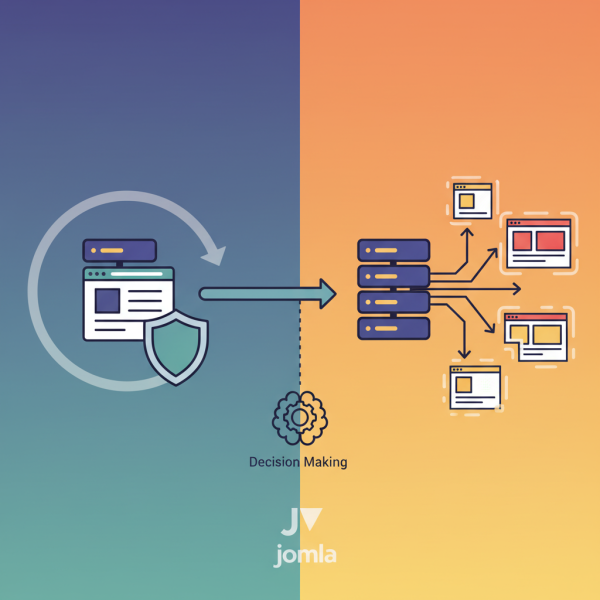
Conservative caching, often referred to as 'page caching' or 'static caching,' involves storing the complete rendered output of a web page. When a user requests a page, the server first checks if a cached version of that exact page exists. If it does, the server serves the static HTML file directly, bypassing most of the Joomla application's processing. This approach is highly efficient because it minimizes server interaction and PHP execution.
The 'conservative' aspect refers to how frequently the cache is updated. In a conservative caching setup, the cached content is typically retained for a longer duration, or until a specific event triggers its invalidation, such as saving an article or updating a module. This strategy assumes that the content on most pages changes infrequently, making long cache lifetimes viable. It's an excellent choice for websites with mostly static content or content that is updated on a predictable schedule.
Progressive Caching Explained
Progressive caching, sometimes called 'dynamic caching' or 'fragment caching,' takes a more granular approach. Instead of caching entire pages, it caches specific components, modules, or database query results that are frequently accessed. The page itself is still dynamically built for each request, but the heavy lifting parts (like complex database queries for a popular module) are served from the cache.
This method is 'progressive' because it allows for more up-to-date content on parts of the page while still gaining performance benefits from caching stable elements. For instance, a Joomla site might cache its navigation menu and footer (which rarely change) but dynamically render the main article content (which updates frequently). This allows for a balance between freshness and performance. Progressive caching often involves shorter cache lifetimes for individual components, making it more adaptable to frequently changing content.
When to Choose Conservative Caching
Conservative caching is a powerful choice for specific types of Joomla sites:
- Blogs and News Sites: If your content is published periodically and doesn't change much after publication, conservative caching can deliver excellent performance.
- Brochure Websites: Sites primarily serving static information about a business, product, or service benefit greatly from serving pre-built pages.
- High-Traffic Sites with Infrequent Updates: For sites experiencing massive traffic spikes where content updates are rare, conservative caching drastically reduces server load.
- SEO Focus: Faster page loads directly contribute to better search engine rankings, making this ideal for sites where SEO is a top priority and content stability is high.
The primary benefit is raw speed and significant server resource reduction. The drawback is that content changes might not be immediately visible to users until the cache expires or is manually cleared. This can be problematic for highly interactive or rapidly updating sites.
When to Choose Progressive Caching
Progressive caching offers flexibility and is suited for more dynamic Joomla applications:
- E-commerce Stores: Product prices, stock levels, and user-specific carts need to be up-to-date. Caching static elements like categories and product descriptions, while dynamically rendering pricing and inventory, is ideal.
- Membership Sites: Content tailored to logged-in users or specific membership levels requires dynamic generation. Caching common elements while allowing personalized content to update is key.
- Interactive Portals: Websites with user-generated content, forums, or frequently updated data feeds will benefit from caching only the stable parts and keeping dynamic elements fresh.
- Sites with Personalization: When content changes based on user behavior, location, or other dynamic factors, progressive caching allows for a blend of performance and personalized experience.
The main advantage here is maintaining content freshness while still achieving performance gains. The trade-off is that it might not be as fast as a purely conservative cache for every single page request, as some dynamic processing is still required.
Making the Right Choice for Your Joomla Site
The decision between conservative and progressive caching, or even a hybrid approach, depends entirely on your Joomla site's specific characteristics and goals. Consider your content's update frequency, the level of personalization required, and your audience's expectations for real-time information. For many Joomla sites, a layered approach combining both strategies offers the best of both worlds. For instance, you might use a conservative page cache for anonymous users viewing static content, and then use progressive caching for logged-in users or areas of the site that require more dynamic interaction.
Experimentation and monitoring are key. Joomla's built-in caching options, along with extensions like JCH Optimize or RegularLabs' Cache Cleaner, provide tools to implement and manage these strategies. Regularly check your site's performance metrics to understand the impact of your caching choices and fine-tune them as needed. The goal is always to deliver the fastest, most reliable experience for your users without compromising content accuracy or functionality.
Summary
This article explored the fundamental caching strategies of Conservative and Progressive Caching, detailing their operational differences and ideal use cases within a Joomla environment. We learned that conservative caching excels for static, infrequently updated sites by serving full cached pages quickly, while progressive caching offers greater flexibility for dynamic content by caching individual components. Understanding your site's content update frequency and personalization needs is crucial for selecting the appropriate caching method, which can significantly boost performance, improve user experience, and optimize server resource utilization for any Joomla website.
Comprehension questions
 What are the two primary caching philosophies discussed in the article for Joomla websites?How does conservative caching differ from progressive caching in terms of what is cached and its typical cache lifetime?For what types of Joomla websites is conservative caching most suitable, and what is its main drawback?When would a Joomla site administrator choose progressive caching, and what advantages does it offer over conservative caching?