Understanding Common Cybersecurity Attack Vectors
- -->> 2. Understanding Common Cybersecurity Attack Vectors
What you'll learn
 Brute-Force Attack MechanicsSQL Injection VulnerabilitiesCross-Site Scripting ExploitationMalware Types and Defenses
An attack vector represents the path or means by which a cybercriminal gains unauthorized access to a computer, server, network, or application to deliver a malicious payload or exploit a vulnerability. These vectors are diverse, constantly evolving, and leverage various weaknesses, from human error to software flaws. Recognizing and mitigating these common entry points is the first line of defense in building resilient security postures.
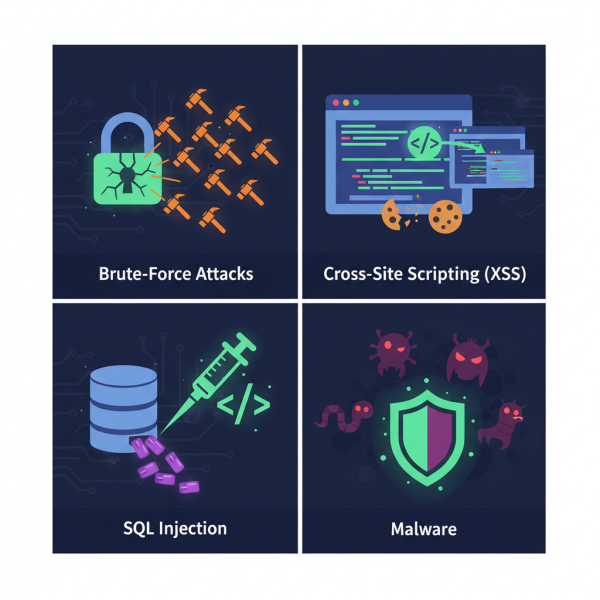
Brute-Force Attacks
Brute-force attacks are among the oldest and most straightforward methods employed by attackers. They involve systematically trying every possible combination of characters until the correct password or encryption key is discovered. While seemingly primitive, these attacks can be highly effective, especially against weak or common passwords, and are often automated using specialized software. The attacker simply cycles through a vast dictionary of potential credentials or character sets, attempting to log in until successful.
There are several types of brute-force attacks:
- Simple Brute-Force: Trying all possible combinations.
- Dictionary Attacks: Using a list of common passwords, phrases, and permutations.
- Hybrid Brute-Force: Combines dictionary attacks with numeric and symbolic variations.
- Reverse Brute-Force: Starting with a known password and trying to find usernames that use it.
The impact of a successful brute-force attack can range from unauthorized access to sensitive data, financial theft, or even complete system compromise. Mitigation strategies typically involve implementing strong password policies, multi-factor authentication (MFA), account lockout mechanisms after several failed attempts, and rate limiting login attempts.
SQL Injection
SQL Injection (SQLi) is a code injection technique used to attack data-driven applications, in which malicious SQL statements are inserted into an entry field for execution (e.g., to dump the database content to the attacker). This vulnerability arises when an application constructs SQL statements using user-supplied input without proper validation or sanitization. By manipulating input fields, an attacker can trick the database into executing unintended commands, potentially revealing, modifying, or deleting sensitive data.
A successful SQL injection can allow attackers to:
- Bypass authentication and authorization.
- Retrieve sensitive data from the database.
- Modify database data.
- Execute administrative operations on the database.
- In some cases, issue commands to the operating system.
Preventing SQL injection largely depends on secure coding practices. Parameterized queries (prepared statements), input validation, and using Object-Relational Mappers (ORMs) are highly effective methods. Limiting database user privileges to the bare minimum required for an application's operation also adds a layer of defense.
Cross-Site Scripting (XSS)
Cross-Site Scripting (XSS) attacks are a type of injection, in which malicious scripts are injected into otherwise benign and trusted websites. XSS attacks occur when an attacker uses a web application to send malicious code, generally in the form of a browser-side script, to a different end user. The attacker gains control of the victim's browser, potentially stealing cookies, session tokens, or other sensitive information, or even redirecting them to malicious sites. These scripts can then execute on the user's browser, as if they were part of the legitimate website.
XSS attacks are commonly categorized into three types:
- Stored XSS: The malicious script is permanently stored on the target server (e.g., in a database, in a comment field).
- Reflected XSS: The malicious script is reflected off of a web server, such as in an error message, search result, or any other response that includes some or all of the input sent by the user.
- DOM-based XSS: The vulnerability lies in the client-side code, where the malicious payload is executed as a result of modifying the Document Object Model (DOM) environment in the victim's browser.
Defenses against XSS include strict input validation and sanitization, encoding output to prevent the browser from interpreting user-supplied data as executable code, and implementing a Content Security Policy (CSP) to restrict which scripts can run on a page.
Malware
Malware, a portmanteau for malicious software, is a broad term encompassing any software intentionally designed to cause damage to a computer, server, client, or computer network, or to gain unauthorized access to computer systems. Malware can manifest in various forms, each with its own method of infection and intended impact. From disrupting operations to stealing data, malware poses a significant threat to digital security.
Common types of malware include:
- Viruses: Attach themselves to legitimate programs and spread when the program is executed.
- Worms: Self-replicating and can spread across networks without human interaction.
- Trojans: Masquerade as legitimate software but carry malicious payloads.
- Ransomware: Encrypts files and demands a ransom for their release.
- Spyware: Secretly monitors and collects user information.
- Adware: Displays unwanted advertisements.
Protection against malware involves a multi-layered approach including robust antivirus and anti-malware software, regular software updates and patching, firewalls, network segmentation, user education, and practicing safe browsing habits. Regular backups of critical data are also essential to recover from ransomware or data corruption incidents.
Conclusion
The digital world is constantly under threat from various attack vectors, each with its unique characteristics and methods of exploitation. From the persistence of brute-force attacks to the cunning manipulation of SQL injection, the insidious scripts of cross-site scripting, and the diverse dangers of malware, understanding these common threats is paramount. Effective cybersecurity relies on a combination of technical safeguards, vigilant monitoring, and continuous education to defend against these pervasive and evolving dangers, ensuring the integrity, confidentiality, and availability of digital information and systems.
Comprehension questions
 What is the primary goal of a brute-force attack and what are two common mitigation strategies?How does SQL injection allow an attacker to gain unauthorized access or manipulate data?What are the three main types of Cross-Site Scripting (XSS) attacks, and how do they differ?Name three common types of malware and describe their primary function.
Community Poll
Next Lesson
Course Contents : WordPress Security Essentials
- >> 2.
 Understanding Common Cybersecurity Attack Vectors